Woodz Cycling is reader-supported. When you buy through links on our site, we may earn an affiliate commission at no extra cost to you. As an Amazon Associate we earn from qualifying purchases.
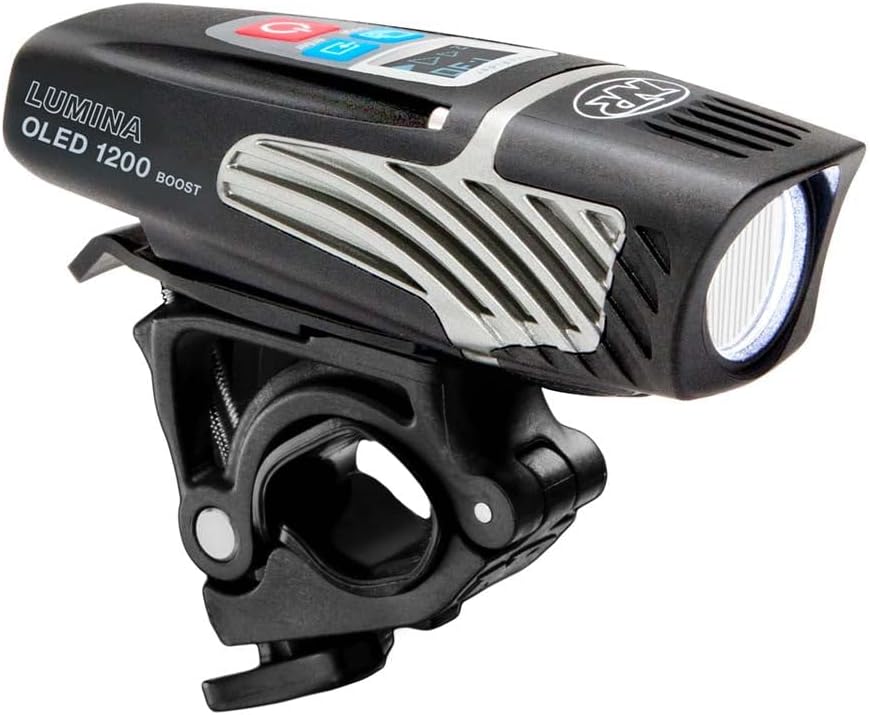
Most headlights tell you they are running low with a single blinking LED, usually at the worst possible moment on a dark road. The NiteRider Lumina OLED Boost 1200 takes a different approach: a small screen on top shows the current mode, the battery percentage and the runtime left in that mode as actual hours and minutes.
That screen sits on top of a proper see-by light. With up to 1,200 lumens in Boost mode, a wide collimator beam and an IP64 housing, this is a headlight built for unlit roads, rural commutes and night trails rather than lit city blocks. We looked at the specs, the buyer feedback across 675 ratings and the main rivals to work out who should spend the money.
Premium see-by headlight
NiteRider Lumina OLED Boost 1200
A genuinely bright, well-built headlight whose OLED runtime readout removes the guesswork from long or dark rides, with the usual caveats about mounts and long-term battery health.
Who needs a 1,200-lumen headlight?
The first question is not whether the Lumina is good, but whether you need this much light. Bike lights do one of two jobs. A be-seen light makes sure drivers notice you on streets that are already lit; 100-300 lumens with a flash mode does that. A see-by light has to illuminate the road far enough ahead to spot potholes, glass and curbs in time, and that typically takes 600 lumens or more.
The Lumina OLED is a see-by light with headroom. On a dark country road or a park path with no lighting, a medium mode will already outperform any budget headlight, and Boost gives you the full 1,200 lumens for fast descents or technical trail sections. If you are not sure where your commute falls, our guide to understanding lumens for cycling lights explains the thresholds.
If your entire ride is under streetlights, this light is more than you need. That is not a criticism; it simply means a cheaper light, such as the Ascher set we reviewed, is the better use of your money.
The OLED display: why it matters
Every headlight has a battery problem: runtime depends on mode, and most lights give you no way of knowing how long you have left. NiteRider’s answer is the OLED screen, which shows the active mode, the battery as a percentage and the remaining runtime in time rather than as a vague bar.
In practice that changes how you ride. If you leave work with 40 minutes of Boost showing and an hour of riding ahead, you know to start in a lower mode and save Boost for the unlit stretch. On a long night ride you can plan rather than guess. Buyers single out the display as one of the things they like most, and it is the main reason to choose this model over the cheaper Lumina 1200 Boost, which shares the output but not the screen.
The light also has a lock-out mode, which stops it switching on in a bag, and NiteRider states that output and runtime are FL1 tested. FL1 is an industry standard for measuring flashlight output and runtime, so the figures are more trustworthy than the inflated lumen claims common on unbranded lights.
Beam, modes and build
NiteRider uses a collimator lens that spreads the light into a wide, even pattern with plenty of peripheral spill. That suits mixed riding: you see the road edge and the curb, not just a bright spot in the middle. The trade-off with any round beam is that it does not have the sharp upper cut-off of German-style road lights, so angle it downward and drop the mode when you meet oncoming riders or drivers.
There are nine modes in total, spanning high-output night settings and flash patterns for daytime visibility. Double-tapping the button jumps to Boost, which is handy when you hit a dark section and want full output without cycling through every mode.
The housing combines fiberglass-reinforced nylon with an integrated aluminum heat sink. Heat management matters at high output, since LEDs and batteries both dislike running hot. The IP64 rating means the light is dust-tight and protected against splashing water from any direction, which covers riding in rain. At about 6.1 oz (172 g) it is noticeably heavier than compact commuter lights, though still easy to carry when you lock up.
Charging is over USB, and NiteRider’s IntelliCharge system charges faster when you use a higher-amp adapter.
Mounting
The Lumina clips into a handlebar mount and slides off for charging or when you park. On the sister Lumina 1200 Boost listing, NiteRider says the mount fits standard and oversized bars up to 35 mm. Mounting is one of the more mixed topics in buyer feedback: many owners find the bracket sturdy, while others report the light coming loose or falling off during rides.
That pattern usually comes down to bar diameter, rough surfaces and how firmly the mount is tightened. Check the bracket before every ride on cobbles or gravel, and if you ride technical trails, consider a helmet mount as a backup for keeping the light secure.
What buyers say
Across 675 ratings the Lumina OLED Boost 1200 averages 4.5 out of 5, which is high for a premium headlight. Amazon’s summary of customer reviews points to these themes:
- Praised: brightness, build quality, the OLED display and the range of lighting modes, including the flashing options. Many owners say it is well worth the money.
- Mixed: battery life and mounting. Some find the battery strong and the bracket solid; others report the battery no longer holding a charge or the light falling off mid-ride.
- Mixed: lifespan, with some owners describing years of use and others reporting a shorter life.
The positives are the core of the product: brightness, display and build. The negatives are the same issues that show up across almost every rechargeable headlight, at every price. Register the light and keep the receipt so that a warranty claim is straightforward if the battery fades early.
How it compares
The closest rival is the Cygolite Metro series, which offers up to 1,100 lumens in a lighter 150 g body and adds Cygolite’s SteadyPulse mode, a steady beam with overlapping pulses that helps drivers notice you. It lacks a runtime screen, but it has a long track record and more ratings.
If you like NiteRider’s beam but do not care about the display, the standard Lumina 1200 Boost has the same peak output and housing for less, though it has a lower 4.2-star average across 1,324 ratings. Pair whichever headlight you choose with a bright taillight such as the Cygolite Hypershot 350: a strong front light does nothing for drivers coming up behind you.
What we like
- 1,200-lumen Boost mode is real see-by light for unlit roads and trails
- OLED screen shows mode, battery percentage and remaining runtime as actual time
- Nine modes, including daytime flash, cover everything from night trail to sunny commute
- IP64 housing with an aluminum heat sink, from a long-established light brand
- FL1-tested output and runtime, so the numbers on the box mean something
What could be better
- At roughly 6 oz it is heavier than compact commuter lights
- Some buyers report the bar mount loosening or the light falling off on rough roads
- A minority of owners report batteries losing capacity over time
- Overkill and over budget if you only ride lit city streets
Key specifications
| Maximum output | 1,200 lumens (Boost mode, double tap) |
|---|---|
| Light modes | 9 |
| Display | OLED: mode, battery % and remaining runtime |
| Optics | Collimator lens, wide beam with peripheral spill |
| Water and dust resistance | IP64 |
| Housing | Fiberglass-reinforced nylon with aluminum heat sink |
| Charging | USB rechargeable (IntelliCharge fast charging with higher-amp adapters) |
| Weight | About 6.1 oz (172 g) |
| Extras | Lock-out mode for transport; FL1-tested output and runtime |
Alternatives worth considering
Lighter and simpler
Cygolite Metro series USB headlight
Up to 1,100 lumens in a 150 g body with Cygolite’s SteadyPulse and DayLightning modes. No runtime display, but a strong record with 1,300+ ratings.
View on Amazon →Same light, no screen
NiteRider Lumina 1200 Boost
The same 1,200-lumen Boost output and housing without the OLED display. Worth a look if you are happy reading a simple low-battery indicator.
View on Amazon →Budget be-seen set
Ascher USB Rechargeable Bike Light Set
Front and rear lights for a fraction of the price. Fine on lit streets, but its 300-lumen headlight is no substitute for the Lumina on dark roads.
View on Amazon →Frequently asked questions
Do I really need 1,200 lumens for commuting?
Not under streetlights. The extra output matters on unlit roads, bike paths without lighting and trails, especially above about 15 mph, when you need to spot potholes and debris early. Most riders will spend most of their time in a medium mode and save Boost for the darkest or fastest sections.
How accurate is the runtime display?
NiteRider says the screen shows remaining runtime in actual time for each of the nine modes, and the light’s output and runtime are FL1 tested. Expect the readout to shift as you change modes; that is the point, because it lets you pick a mode that will last the whole ride.
Can I use it in the rain?
The IP64 rating means it is dust-tight and protected against splashing water from any direction, which covers riding in rain. It is not rated for submersion, so do not hose it down at close range.
Will it dazzle oncoming riders and drivers?
Any 1,200-lumen light with a round beam can. Angle it down toward the road surface and drop to a lower mode on shared paths or when facing oncoming traffic.
The verdict
The Lumina OLED Boost 1200 is a serious see-by headlight, and the runtime screen is a useful feature rather than a gimmick: on a long dark ride you know exactly which mode will get you home. Buyers rate it highly for brightness and build, with mixed notes on mounting and battery longevity that are common across this class. If you ride unlit roads or trails, it earns its premium; if you ride lit city streets, the Cygolite Metro or a budget set is enough.
Check the Lumina OLED on AmazonHow we review: we research every product using the manufacturer’s specifications, independent expert sources and patterns across verified customer reviews, then score it against the alternatives in its price class. Prices and availability change often, so always check the current listing on Amazon.