Woodz Cycling is reader-supported. When you buy through links on our site, we may earn an affiliate commission at no extra cost to you. As an Amazon Associate we earn from qualifying purchases.
Most stolen bikes were locked. The problem is usually not that the lock was too weak, but that it was used in a way that made the thief’s job easy: a cable around the front wheel, a U-lock hanging loose around a signpost, a bike left outside the same café every day at the same time.
No portable lock is unbreakable. A determined thief with a battery-powered angle grinder can get through almost anything in minutes. The realistic goal is to make your bike slower, noisier and riskier to steal than the bikes around it. This guide covers the habits and techniques that achieve that, plus the locks worth buying.
Key takeaways
- Your goal is to make your bike slower, noisier and riskier to steal than the ones around it.
- Lock the frame to something solid that cannot be lifted, unbolted or cut.
- Fill the U-lock so there is no room for a jack or lever, and keep it off the ground.
- Use two different lock types in high-risk areas, and record your serial number today.
Locks worth carrying
- 1
Best mid-level U-lock
Kryptonite Kryptolok Standard with 4 ft cableA 12.7 mm double-deadbolt shackle, Sold Secure Silver rating and a cable for the front wheel. Best for suburbs, campuses and short stops in town.
Read our review · Check price → - 2
Best compact U-lock for cities
Kryptonite Evolution Mini-7 with cableSold Secure Gold, a 13 mm shackle and a tight 3.25 x 7 inch interior that leaves little room for leverage attacks.
Check price → - 3
Premium U-lock
ABUS Granit X-Plus 540ABUS’s flagship U-lock, with a 13 mm square parabolic shackle and the pick-resistant X-Plus cylinder, for high-risk parking.
Check price → - 4
Best folding lock
ABUS Bordo 6000K folding lockOpens to 120 cm to reach awkward posts and folds into a frame holster. ABUS security level 10 for medium-risk locking.
Check price →
Start with the right lock
The lock is the foundation, so it is worth being clear about what different types offer.
U-locks (also called D-locks) are the standard for good reason. A hardened steel shackle resists bolt cutters, and a double-bolted design, where the shackle locks into the crossbar on both sides, resists twisting. Look for a shackle of at least 12-13 mm from a recognized security brand.
Folding locks use hardened steel plates connected by rivets. They fold into a compact holster on the frame and open out to a longer reach than most U-locks, which helps at awkward posts. The better ones offer mid-level security.
Chain locks with thick hardened links can be very secure, but serious ones are heavy. They suit bikes kept at home or work, where the lock can stay at the location.
Cable locks are light and convenient but can be cut quickly with hand tools. Use them only as a secondary lock for wheels and accessories.
Independent ratings help you compare. Sold Secure, a UK test house, grades bicycle locks Bronze, Silver, Gold and, for the toughest, Diamond. Brands like Kryptonite and ABUS also publish their own security scales. As a rough guide: Silver for suburbs and short stops, Gold or higher for city centers and long stays. Our Kryptonite Kryptolok Standard review walks through what a Silver-rated U-lock does and does not protect against.
Choose where you lock
The location matters as much as the lock. A few principles:
- Busy and visible beats quiet and hidden. Thieves prefer places where they can work unobserved. Choose spots with foot traffic, good lighting and, ideally, cameras.
- Indoor and controlled beats outdoor. If your office, campus or apartment building has a secure bike room, use it.
- Vary your routine. A bike locked at the same rack at the same time every day is easy to plan for. Where you can, change spots.
- Stand out as the harder target. If yours is the best-locked bike at the rack, thieves usually move on to an easier one.
Choose what you lock to
Before you lock, check the object, not just the lock.
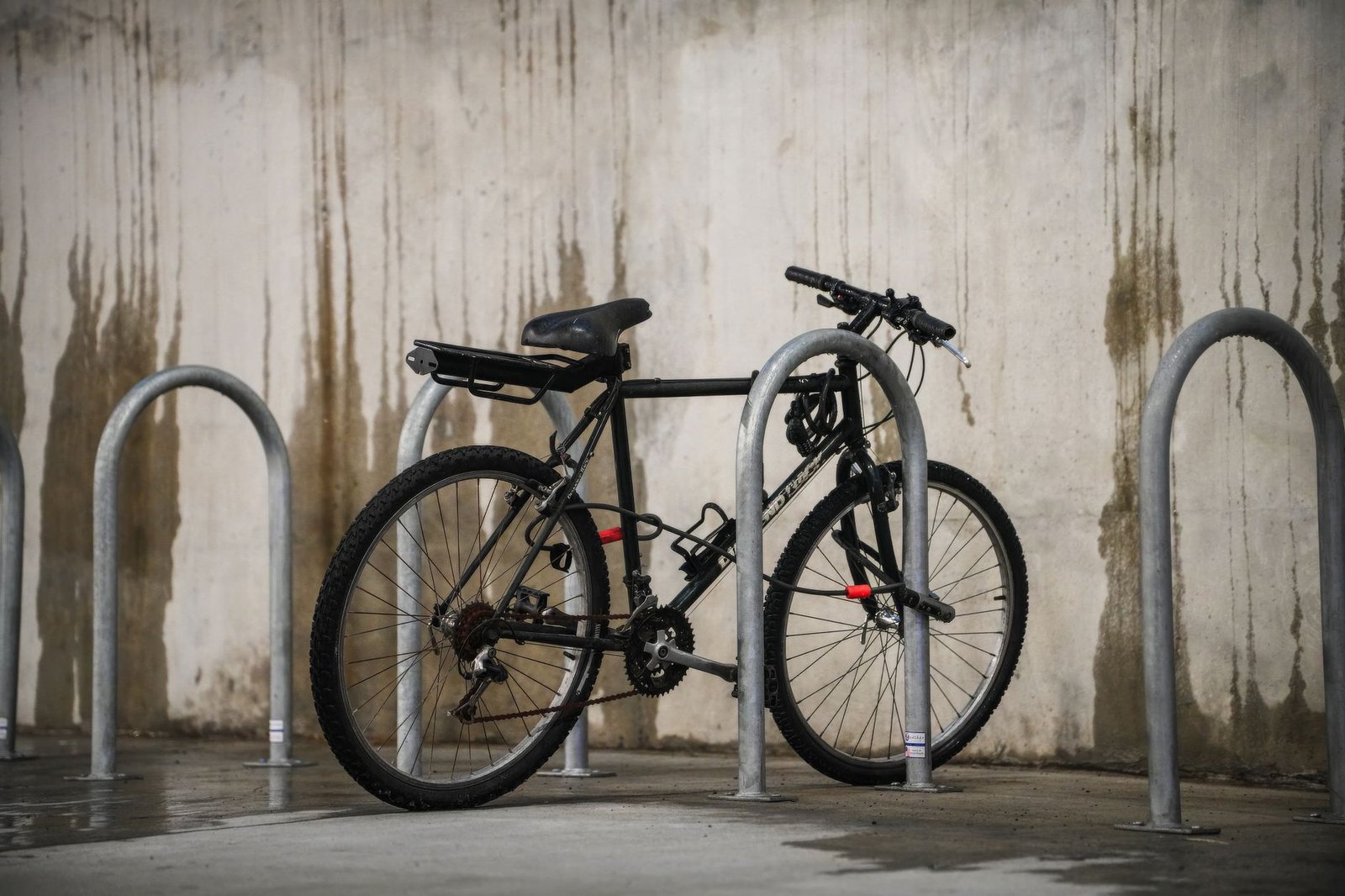
A good anchor is a solid metal rack or post, bolted or set into concrete, with no way to lift the lock over the top. Avoid short signposts, where a thief can lift the bike over the sign or unbolt the sign itself. Avoid wooden posts, small trees, chain-link fences and railings with thin bars, which can be cut faster than your lock.
Give the rack a tug and look at its bolts. Thieves sometimes loosen a rack in advance and come back later for the bikes locked to it.
Lock it properly: the technique
Lock the frame, not just a wheel. A lock through only the front wheel leaves the rest of the bike free to walk away. Pass the U-lock through the rear triangle or main frame and the rack.
Fill the U. The less empty space inside the lock, the harder it is to insert a car jack or bar and pry it apart. Position the bike so the frame and rack take up as much of the shackle as possible. This is the main reason city riders choose compact locks.
Keep the lock off the ground. A lock resting on the pavement can be braced against the ground and attacked with a hammer or bolt cutters. Position it higher on the frame.
Point the keyhole down. It makes the cylinder harder to reach and keeps rain and dirt out.
Secure the wheels. A popular approach, often credited to the late bike mechanic Sheldon Brown, is to lock a small U-lock through the rear wheel inside the rear triangle, which also holds the frame because the wheel cannot pass through the triangle. Many riders prefer to lock the frame and rear wheel together with the U-lock, then loop a cable through the front wheel and back to the shackle. Bikes with quick-release wheels or seat posts are especially vulnerable; consider security skewers or locking bolts if you park outside often.
Strip the bike. Take lights, computers, bags and anything else that unclips. Lights left on a parked bike tend to disappear quickly.
Use two locks when the risk is high
In big city centers, at train stations and anywhere you leave the bike for hours, two locks of different types make sense: for example, a U-lock for the frame and rear wheel plus a folding lock or heavy cable for the front wheel. A thief then needs two different tools and twice the time. The extra weight is worth it on those days; on a quick stop in a quieter area, one good lock is usually enough.
Record, register and insure
Theft prevention also covers what happens if prevention fails.
- Write down your frame’s serial number, usually stamped under the bottom bracket, and take clear photos of the bike, including any distinctive marks.
- Register the bike with a bike registry, such as Bike Index in the US, and with any local or campus scheme. Registered bikes are easier to identify and return.
- Register your lock and keys. Brands like Kryptonite offer key replacement programs and anti-theft offers for registered locks.
- Check your insurance. Some home or renter’s policies cover bikes away from home; others require a specific rated lock. Read the terms before you need them.
Common mistakes to avoid
- Leaving the bike unlocked “just for a minute” outside a shop.
- Locking only the front wheel or only a quick-release wheel.
- Using a thin cable as the only lock.
- Locking to an object that can be lifted, unbolted or cut.
- Leaving the lock loose and low, with plenty of room for tools.
- Storing the bike overnight in an unlocked shed or shared hallway.
A lock is only as good as the way it is used. Combine a solid lock with smart locking and you change the odds in your favor. For more security gear ideas, see our roundup of essential cycling security gear for urban cyclists, and if you ride after dark, our guide to the best bike lights for commuting.
Frequently asked questions
Is one good lock enough?
For short stops in low-risk areas, a good U-lock or folding lock used correctly is usually enough. For long stays in city centers, at stations or overnight, two different lock types make a theft slower and require a thief to carry two sets of tools.
Are cable locks any good?
Thin cables can be cut quickly with hand-held cutters, so they should never be your main lock. They are useful as a secondary lock for wheels, seats and accessories, looped back to a U-lock.
Where is the safest place to lock a bike?
A secure, staffed or access-controlled bike room is best. Outside, pick a busy, well-lit spot in view of people or cameras, at a solid rack bolted into concrete, ideally next to other bikes that are locked less well than yours.
What should I do if my bike is stolen?
Report it to the police with your serial number and photos, register it as stolen on any bike registry you use, and check local resale listings. Having your serial number and receipt ready makes every step faster, including an insurance claim.